
GoldPrice ConverterLoading live prices…
Live Kazakhstan gold rate in KZT, by karat and weight.
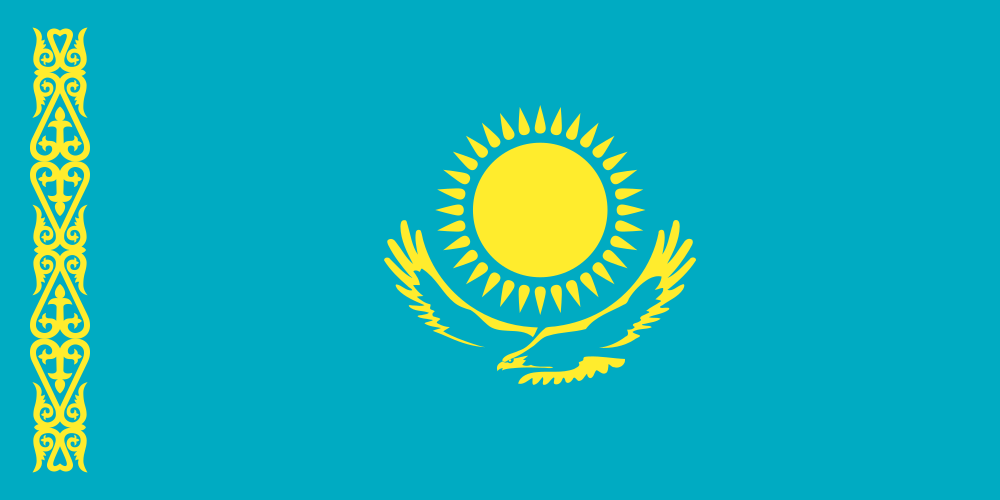
The international gold spot price is quoted in US dollars and is the global benchmark from which every local rate is derived. Prices exclude dealer premiums, making charges, and local taxes.
| Purity | Per Gram | Per Ounce | Per Tola | Per Kilo |
|---|---|---|---|---|
| 24K Gold (99.99%) | ₸ 58,975.44 | ₸ 1,834,341.22 | ₸ 687,877.96 | ₸ 58,975,439.83 |
| 22K Gold (91.60%) | ₸ 54,026.91 | ₸ 1,680,424.60 | ₸ 630,159.23 | ₸ 54,026,905.57 |
| 21K Gold (87.50%) | ₸ 51,608.67 | ₸ 1,605,209.09 | ₸ 601,953.41 | ₸ 51,608,670.72 |
| 18K Gold (75.00%) | ₸ 44,236.00 | ₸ 1,375,893.51 | ₸ 515,960.07 | ₸ 44,236,003.47 |
Chart values are in US dollars. Per gram, tola and ounce figures above are USD. Today’s local-currency price uses the live exchange rate; historical values stay in USD because reliable historical exchange-rate data isn’t available. Candles are reconstructed from real high, low and average data.
Turn the international USD spot price into a local per-gram, per-tola and per-ounce rate in a few simple steps.
24K and 22K gold valued across the weight units used in Kazakhstan, at today’s KZT rate.
| Unit | Weight | 24K | 22K |
|---|---|---|---|
| Gram | 1 g | ₸ 58,975.44 | ₸ 54,026.91 |
| Troy Ounce | 31.1035 g | ₸ 1,834,341.22 | ₸ 1,680,424.60 |
| Popular karat | 585 (14K) & 18K |
| Hallmarking | Assay stamp |
| Tax / duty | VAT on jewelry |
| Common units | Gram |
Gold in Kazakhstan is quoted in tenge (KZT), converted from the international dollar price. Kazakhstan is a significant gold producer, and its central bank buys domestic gold.
The tenge gold price reflects both the global metal price and the USD/KZT exchange rate.
Gold is priced nationally, so the Kazakhstan rate shown above applies across all major cities — including:
Kazakhstan is one of the world’s significant gold producers, and its National Bank runs a retail programme selling certified investment-grade gold bars to the public. Gold is priced in tenge.
Investment bars are 999.9 fine, while jewellery is commonly 585 (14K), a regional standard. Local prices reflect the world price and the USD/KZT exchange rate.
Yes — Kazakhstan is a major gold producer, and its central bank is an active buyer of domestically mined gold.
It is the international spot price converted into tenge at the live exchange rate.
585 (14K) and 750 (18K) are common hallmarks for jewelry.
The live gold rate in Kazakhstan is shown above in KZT, with 24K, 22K, 21K and 18K prices per gram and local units, refreshed through the trading day.
It is the international spot price (US dollars per troy ounce) converted into KZT at the live exchange rate, then divided by weight and adjusted for karat purity.
Two forces move it: the global gold price and the KZT exchange rate. On top of that benchmark, jewelers add making charges and any local taxes or duties.
 United States
 India
India United Kingdom
 Canada
 United Arab Emirates
 Saudi Arabia
 Pakistan
 Japan
Japan China
China Australia
 Switzerland
 Eurozone
 Afghanistan
 Algeria
 Argentina
 Armenia
 Austria
 Azerbaijan
 Bahrain
 Bangladesh
 Belgium
 Bolivia
 Brazil
 Brunei
 Bulgaria
 Cambodia
 Chile
Chile Colombia
 Croatia
 Cyprus
 Czech Republic
 Denmark
 Egypt
Egypt Estonia
 Ethiopia
 Finland
 France
 Germany
 Greece
 Hong Kong
 Hungary
 Indonesia
 Iran
Iran Iraq
Iraq Ireland
 Italy
Italy Jordan
 Kenya
Kenya Kuwait
 Lebanon
 Libya
Libya Luxembourg
 Malaysia
 Maldives
 Mexico
 Morocco
 Nepal
Nepal Netherlands
 New Zealand
 Nigeria
 Norway
 Oman
Oman Philippines
 Poland
 Portugal
 Qatar
Qatar Romania
 Russia
 Singapore
 South Africa
 South Korea
 Spain
Spain Sri Lanka
 Sweden
 Syria
Syria Taiwan
 Thailand
 Tunisia
 Turkey
 Ukraine
 Uzbekistan
 Vietnam
 Zimbabwe